HE SUGGESTS A DATE.
you turn it into a plan.


What’s harder to see is when you’re the reason why it’s working.
HE SUGGESTS A DATE.
you turn it into a plan.
HIS WEEK GETS DIFFICULT.
you adapt to see him.
A CONVERSATION GETS UNCOMFORTABLE.
you know how to make it easier for him.
None of that feels like over-functioning.
IT FEELS LIKE BEING GOOD AT RELATIONSHIPS.
The danger is when your competence hides what he’s not bringing.
A structured 30-day system to help you see what’s actually happening before you’re deeply invested.
GET THE MAN FILTER →WHAT’S INSIDE
The 30-Day Man Filter gives you a practical way to see what’s actually happening before chemistry, hope, or attachment start explaining away what you would have noticed immediately in someone else.
Know exactly what to watch for early, including planning, follow-through, curiosity, effort, emotional regulation, and how he handles frustration, disappointment, or not getting his way.
So instead of replaying the date afterward wondering if you’re being too picky, you’ll know what deserves more time, and what may already be showing you enough.
Step out of the chemistry once a week and look at what’s actually developing across initiative, consistency, emotional maturity, and real-life compatibility.
Because a connection can feel exciting while you’re slowly becoming the one initiating more, excusing more, and expecting less.
Get clear on what you truly require before you like him enough to start negotiating with yourself.
Separate genuine standards from preferences, hopes, and “nice-to-haves,” so attraction doesn’t quietly turn your non-negotiables into things you suddenly decide you can live without.
Catch the moment you start rationalizing, minimizing, over-explaining, or doing extra work to keep the connection alive.
Separate what actually happened from the story you’re creating around it, so you can stop talking yourself out of what his behavior is already showing you.
Put the pattern on paper and see whether his behavior is giving you more or less reason to keep investing.
You’ll track the trajectory: Is this becoming more consistent, mutual, and secure? Or are you becoming more invested while receiving roughly the same amount, or less, in return?
Know the difference between one imperfect moment, a pattern worth watching, and behavior you don’t need another month of evidence to understand.
By Day 30, you’ll have a concrete way to decide whether to continue, slow down, or step away before uncertainty turns into months of waiting for the relationship to become what you hoped it would be.
ALSO INCLUDED
Recognize the thinking patterns that can make obvious problems surprisingly easy to overlook, including the Potential Trap, the Best-Day Fallacy, false urgency, the Exception Narrative, and over-functioning.
So you can catch the moment you stop evaluating what he’s actually doing and start protecting the possibility of who you hope he could become.
Whatever happens with him at Day 30, see what the process revealed about you: where you trusted yourself, where you started bending, what pulled you off-center, and what you want to recognize sooner next time.
So even when a connection isn’t right, you leave it with more clarity and self-trust instead of another round of “How did I end up here again?”
The entire process condensed into one simple week-by-week map, with the questions, checkpoints, and signals you need at each stage.
So when you’re actually dating him and your emotions are loudest, you have something concrete to come back to instead of relying on memory, chemistry, or whatever happened on the last great date.
You’re still observing.
You like him. The good moments start carrying more weight.
You’ve adjusted a few things. Each one made sense on its own.
You understand him better. Which also means you have more explanations available.
You may no longer be looking only at what he brought.
Long enough to see the pattern. Early enough to see it clearly.
30 days gives behavior time to repeat before emotional attachment has had months to reinterpret it.
You don't need certainty about him.You need enough clarity to make your next decision.
Not a tactic.
Not a test.
Not a way to make him chase.
The goal isn’t to change his behavior.
It’s to see it clearly before you invest more.
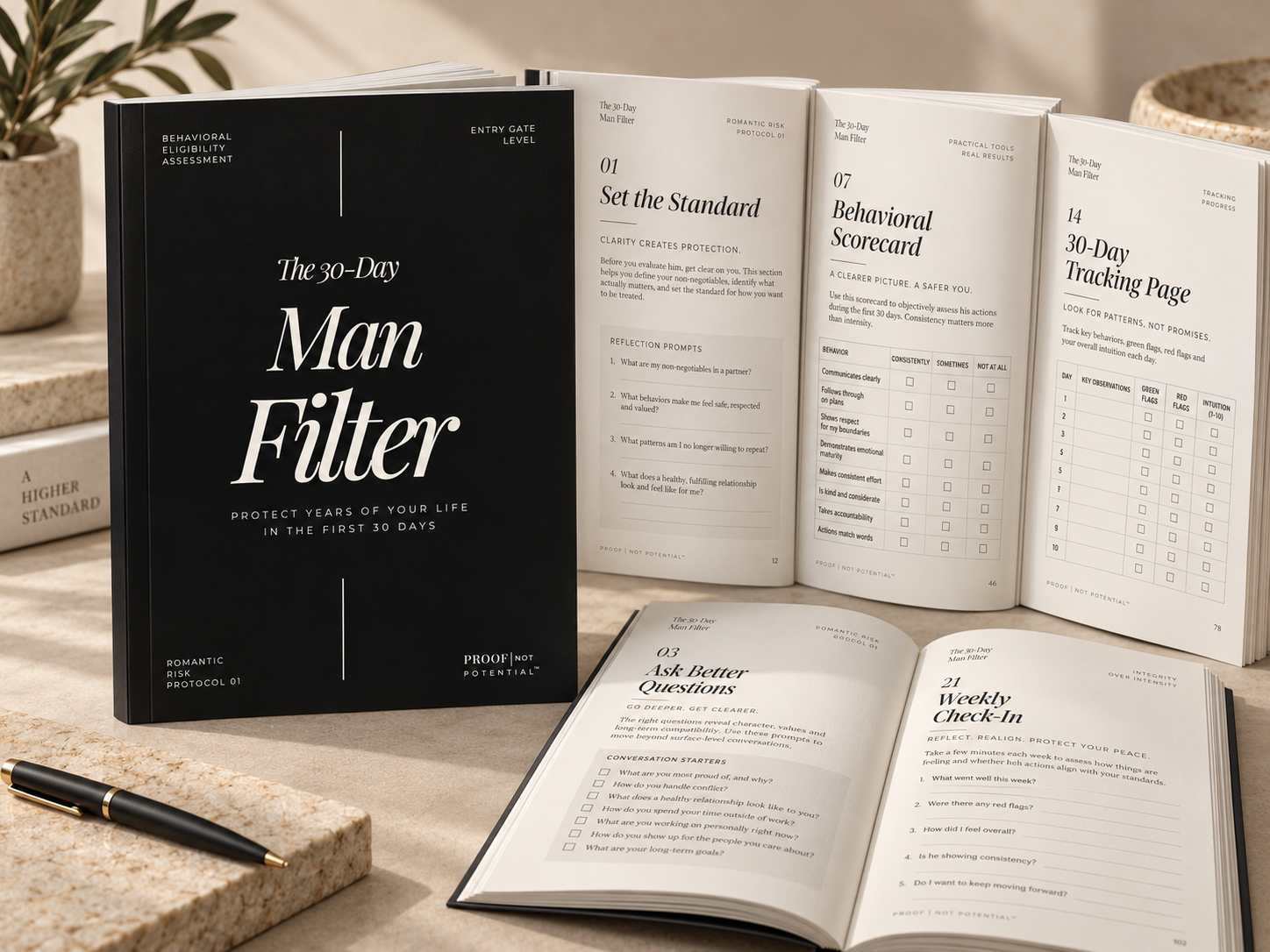
GET STARTED TODAY
The 30-Day Man Filter
A 30-Day Dating Evaluation Guide for women 35+
INSTANT ACCESS · PROTECT YEARS OF YOUR LIFE IN THE FIRST 30 DAYS.
FAQ
No. The point is the opposite.
Instead of analyzing every text, date, and interaction in real time, the Filter gives you defined things to observe and specific points at which to step back and review the pattern.
You can still use the filter if you're already dating. It will help you recognize if there are aspects you haven't clearly evaluated yet.
The cleanest use is from the beginning, before attachment has had much time to influence what you make of the evidence.
No.
The Filter looks at repetition and trajectory, not isolated imperfections.
One poor moment does not erase an otherwise strong pattern.
And one extraordinary moment does not repair a consistently weak one.
No.
The Filter is not a dating tactic.
It does not tell you how to manipulate his behavior.
At Proof Not Potential we believe that evidence-based dating is the best way to choose a partner for smart women with standards. The filter helps you observe his behavior more accurately so you can make your own investment decisions from what he consistently shows you. The purpose of the filter is to protect you from overly investing into a man that doesn't match your long-term needs in a relationship.
The framework can be useful at any age.
It was written specifically for women 35+ because time, established lives, past relationship experience, family decisions, and prolonged ambiguity cost her more at this life stage.
No framework can know another person or predict the future of a relationship.
The Filter helps you organize what has actually happened, notice patterns more clearly, and make your own decision with better information.
No.
The 30-Day Man Filter is an educational reflection and behavioral observation framework. It does not diagnose you, diagnose another person, or replace therapy or professional mental-health care.